Kratom and The Law: What 2026 Holds
Kratom Legal Status as of Early 2026The legal status of kratom (Mitragyna speciosa) is complex and varies significantly by location. There is no uniform “yes” or “no” answer for the entire United States or worldwide, as regulations differ at federal, state, local, and international levels. Laws change rapidly, so always verify current statutes in your specific area before possessing, purchasing, or using kratom.United States Federal Status
- Kratom remains legal at the federal level and is not scheduled as a controlled substance under the Controlled Substances Act.
- The DEA considers it a “drug of concern” but has not classified it as controlled.
- The FDA has not approved kratom for any medical use or as a dietary supplement. It actively warns against its use, restricts marketing (especially for concentrated forms), and notes risks like contamination and adverse effects.
- Concentrated alkaloids like 7-hydroxymitragynine (7-OH) face increasing federal scrutiny, with pushes to classify them as Schedule I, though natural leaf kratom remains unscheduled.
State-by-State Status in the United StatesLaws vary widely due to the absence of a federal ban. As of early 2026:
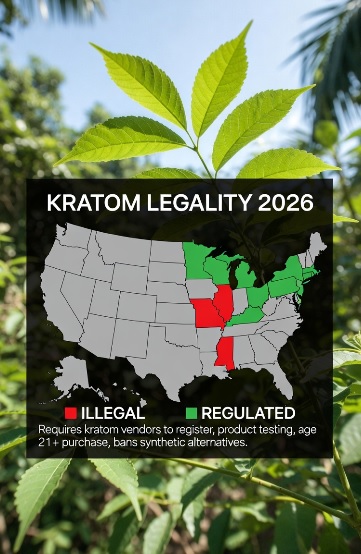
- Fully Illegal States (statewide bans on kratom):
Alabama, Arkansas, Indiana, Rhode Island (note: Rhode Island reversed its ban with regulation effective April 2026 in some prior reports, but confirm current status), Vermont, Wisconsin.
Connecticut recently designated kratom (including derivatives like 7-OH) as a Schedule I controlled substance in February 2026, making it illegal. - States with Partial or Targeted Restrictions (e.g., emergency bans on synthetics/concentrates):
- Ohio: Emergency ban (effective late 2025) on “kratom-related products” including 7-OH and derivatives; natural leaf/vegetation form kratom is exempt.
- Florida: Emergency rules ban concentrated 7-OH products; natural leaf remains legal.
- Regulated States (Kratom Consumer Protection Act – KCPA or similar):
Over 30 states (plus D.C.) have adopted versions of the KCPA or equivalent regulations. These allow kratom but impose requirements like:- Age restrictions (typically 21+)
- Lab testing for purity/contaminants
- Good manufacturing practices
- Specific labeling
Examples include many states beyond the banned ones.
- Local Bans/Restrictions:
Even in states where kratom is generally legal, some cities or counties have independent bans (e.g., San Diego CA, Sarasota County FL, Denver CO, certain areas in California like Oceanside or Jerseyville IL).
International StatusKratom’s legality varies globally:
- Banned/Prohibited in many countries, including:
Australia, Japan, Russia, Denmark, Poland, United Kingdom (under the Psychoactive Substances Act), Malaysia, several others in Europe and Asia. - Legal or Regulated in some places:
- Thailand (decriminalized in 2021, with some regulations).
- Czech Republic (legal as of recent updates).
- Other parts of Europe or regions with no specific bans.
- World Health Organization (WHO): Kratom remains under surveillance but no global ban recommendation has been issued.
Important DisclaimerLaws evolve quickly in 2026, with ongoing debates, emergency rules, and potential federal actions on concentrates like 7-OH. This is a general overview based on available information—always check official state/local statutes, government websites, or legal counsel for your exact location before any actions involving kratom. Regulations can differ by city, county, or even product form (e.g., natural leaf vs. extracts).